
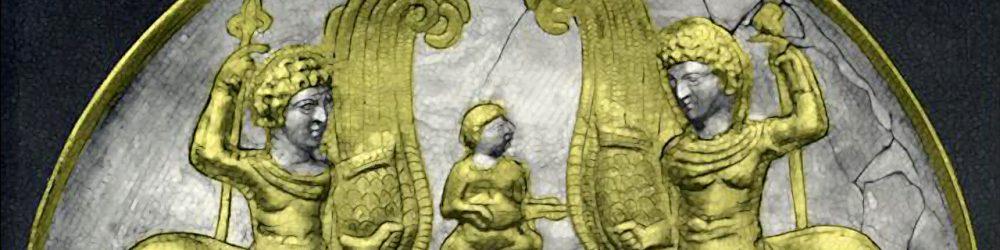
The Twins: An Archetypal Perspective

  In the cosmogony of many archaic cultures, the fundamental duality of life is associated with the two primary sources of light, the sun and the moon.  Each exercising dominion over a separate sky, yet joined in a daily round of death and rebirth, Sun and Moon historically represent the central organizing principles around which many creation myths and religious motifs assemble. The figures are Urthona, Los, and Enitharmon, with solar and lunar emblems of their labors at the “furnaces” and “looms” of generation (18 Serpent temple: Jerusalem (1804-1820), plate 100) However, since the Greek and Roman traditions have come to dominate our mythology, the primary “solar” and “lunar” polarity has in Western culture usually been represented as “masculine” and “feminine.”  Those qualities associated with “solar psychology” – clarity, willfulness, competitiveness, endurance – have been labeled “masculine.  The “lunar qualities” – tenderness, receptivity, intuitiveness, compassion, emotional availability – have been conversely designated “feminine.”  Interestingly, prior to the ascendancy of patriarchal traditions, most mythologies considered the solar principle feminine and the lunar principle masculine. Both solar and lunar principles emerge in the same-sex archetype of male Twins.  The Twins archetype functions to acknowledge the lunar principle as masculine and to personalize

Read More »

The Twins: An Archetypal Perspective

Light & Shadow – Jung Red Book (55) It is important to consider how the Twin archetype differs from the Shadow, which Jung posited as the predominant archetype representing one’s own gender and influencing relationships with one’s own sex.  The Shadow represents that which gets rejected by the conscious Ego.  It contains those potential feelings and behaviors that we choose to disown because they do not fit our “ego-ideal.”  Jung suggested that rejected shadow-impulses emerge in one’s “shadow projections.” In our culture, the Lunar Twin is typically merged in the realm of the Shadow and can only be recognized in men’s damaging projections.  Men tend to project their Lunar Twin onto other men, seeing it as “effeminate” and “homosexual.”  In women, men often idealize lunar attributes, identifying them as the quintessence of “femininity.”  If the Lunar Twin remains undifferentiated within a man’s Shadow, he continues to prevent the possibility of a balanced relationship within himself and with other men or women. While the lunar Twin still resides in the Shadow, a man’s Solar Twin exercises unmitigated power over all the dark contents of the Shadow.  The solar Ego is, by definition, the power of light over darkness: it does not

Read More »

The Twins: An Archetypal Perspective

The birth of biological Twins, past and present, is never a humdrum event.  Twins are blessed, or cursed, with a special energetic charge.  Harris rightly acknowledges that, even in those cultures wherein twins are revered, their elevation to divine status appears to be fueled more by fear than by admiration.  The fear instilled by the uncanny birth of twins is often so well entrenched in a culture that any number of excuses for banishing or disposing of them are promulgated.  Customary in many cultural histories is the practice of sacrificing one twin, typically the second born, and preserving, or even deifying, the other child.  Favored rites of twin sacrifice involve abandoning the child to the elements or burying the infant alive in a special clay pot. Romulus kills Remus Murder of one or both siblings is common, is the regular sacrifice of the twins’ mother or, should her husband retain a liking for her, of a slave woman in her place.  The additional punishment extended to the twins’ mother in many cultures appears to ensure from a common understanding that the habit of one birth at a time regularly distinguishes humankind from other animals.  That the mother, through some unnatural

Read More »